The Most Common Sliding Door Complaint in Orlando Homes
"My sliding door used to glide so easily — now it takes two hands and a shoulder just to move it." This is one of the most common calls we receive at Finest Sliding Door Repair, and it comes from homeowners all across Orlando and Kissimmee regardless of whether their home is a 1980s tract house or a newly built luxury property. The frustrating truth is that a stiff sliding door almost always traces back to one of two components: the rollers, the track, or both working together to make your life harder. Knowing which one is causing the problem helps you understand the repair and set realistic expectations for the result.
Understanding How Rollers and Tracks Work Together
Your sliding patio door panel hangs on a set of roller assemblies built into the bottom rail of the door. These rollers — typically nylon wheels or steel ball-bearing cartridges — ride inside the lower track channel that runs across the floor of the door frame. The upper track keeps the panel from tipping outward but carries very little of the door's weight. When every component is in good condition and properly lubricated, a heavy glass panel that weighs 100 pounds or more slides open with just two fingers of pressure.
When either the rollers or the track degrades, that finger-tip glide turns into a full-body effort. The challenge is that roller wear and track damage produce similar symptoms — grinding, dragging, stiffness — so diagnosing the root cause requires physically removing the door panel and inspecting both components separately.
Signs That the Rollers Are the Problem
Roller wear tends to produce these specific symptoms that distinguish it from track damage:
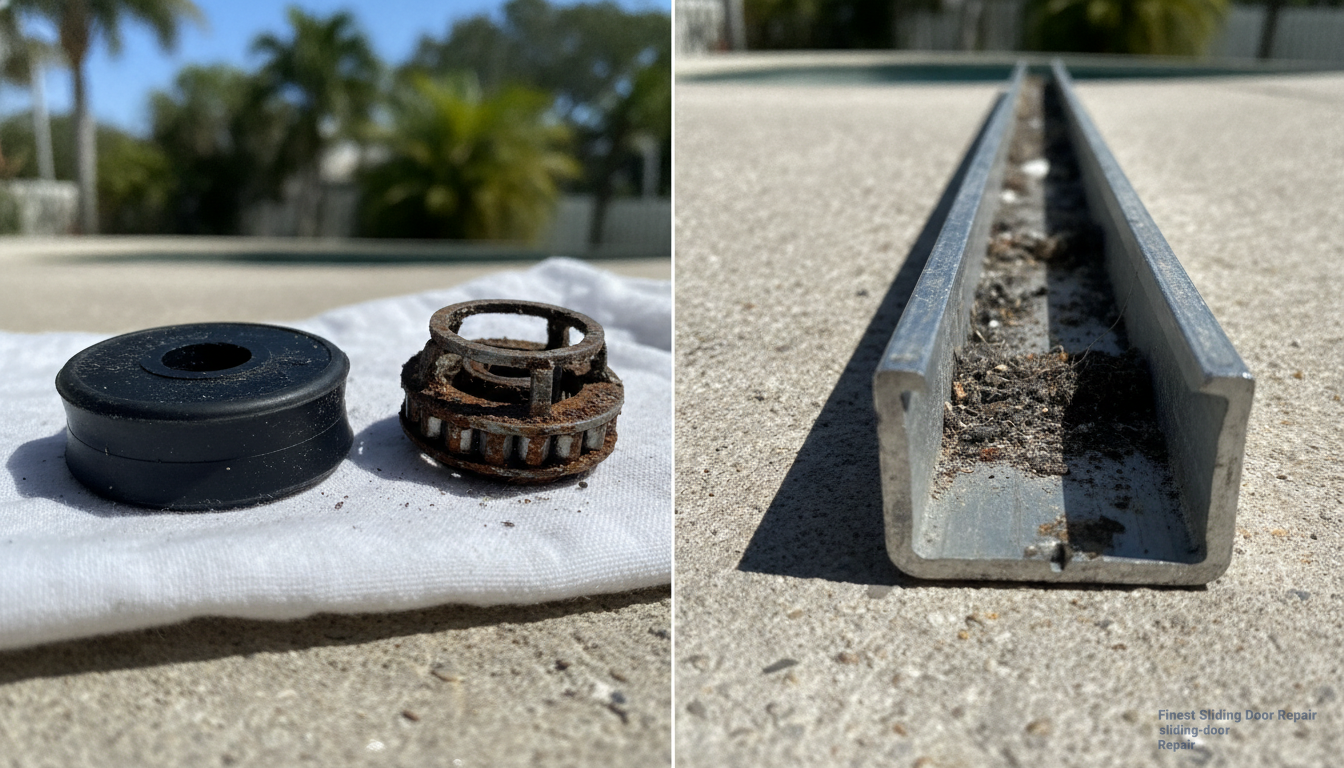
- A rhythmic bumping or vibration as the door moves — nylon rollers develop flat spots from sitting in one position under a heavy load, and each revolution of a flat-spotted roller produces a distinct thump.
- The door feels equally stiff everywhere along its travel — if the resistance is consistent from one end of the track to the other, the rollers are more likely at fault than the track, since track damage tends to be localized.
- The door sits visibly lower in the frame than it used to — roller housings have a height-adjustment screw, and worn rollers lose diameter over time, causing the door panel to drop and drag on the sill.
- Squealing or screeching sounds — seized steel ball-bearing rollers that have lost their lubrication or corroded internally often produce a high-pitched squeal rather than the lower grinding sound associated with track damage.
Our sliding door roller replacement service addresses all of these symptoms by removing the door panel, extracting the old roller cartridges, installing new tandem or single-wheel assemblies, and setting the height adjustment precisely so the door panel sits perfectly plumb and parallel to the frame.
Signs That the Track Is the Problem
Track damage, by contrast, tends to produce localized rather than uniform symptoms:
- The door is smooth in some spots and rough in others — a bent or debris-filled section of track creates a specific trouble zone that the rollers hit at the same point every time.
- The door jumps or bounces at a predictable location — a raised section from a bend or foreign object in the channel causes the rollers to hop rather than roll.
- Visible rust, oxidation, or physical damage in the track channel — you can often see the problem if you get down and look at the lower track with a flashlight.
- The door was recently hit by a heavy object or had heavy furniture dragged over the threshold — physical impact is the most common cause of sudden track damage in Orlando homes.
Our sliding door track repair and replacement service includes a full inspection of both the upper and lower channels, removal of debris and corrosion, and either precision reshaping of the existing track or installation of a new aluminum or stainless-steel profile matched to your door system.
When Both Need to Be Replaced at the Same Time
In many cases — especially in homes where the sliding door has been stiff for a year or more before the owner calls — both the rollers and the track have deteriorated together. Worn rollers deposit metal or nylon particles in the track channel, which acts as an abrasive that accelerates track wear. A damaged track, in turn, causes rollers to wear unevenly because they are constantly being forced against an irregular surface instead of rolling smoothly.
Replacing only one component when both are worn is a common mistake that leads to a second service call within months. Our technicians always inspect both components when they arrive and will show you the condition of each before making a recommendation. Addressing both in a single visit is almost always more cost-effective than two separate appointments.
What About the Lock, Weatherstripping, and Screen?
A stiff or misaligned door frequently causes secondary problems with other components. When the door no longer sits flush in the frame because of worn rollers or a bent track, the lock hook bolt can miss the strike plate entirely or require forceful lifting of the door handle to engage. Our sliding door lock and handle replacement service addresses hook-bolt locks, keyed cylinders, and exterior handles — and we often perform strike plate realignment as part of a roller or track repair at no extra charge.
Similarly, a door that has been dragging for an extended period often has compressed or damaged weatherstripping along the stile and bottom sweep. Our weatherstripping replacement service can be combined with a roller or track repair in a single visit for a complete door restoration that addresses comfort, energy efficiency, and insect exclusion all at once.
DIY vs. Professional Repair: What Kissimmee and Orlando Homeowners Should Know
Several home-improvement videos online make sliding door roller and track repair look simple, but there are a few factors that make professional service the safer and more cost-effective choice for most homeowners in the Orlando area:
- Large patio glass panels weigh between 80 and 200 pounds and require two people and proper handling equipment to remove and reinstall safely.
- Selecting the correct replacement roller cartridge requires matching the housing dimensions, wheel diameter, and axle type — an incorrect roller will either not fit the pocket or will allow the door to sit at the wrong height.
- Track profiles must match the door's bottom roller wheel diameter precisely; a track that is too wide allows the door to wobble laterally, while one that is too narrow prevents the roller from seating.
Our technicians arrive with a full inventory of track profiles, roller cartridges, and alignment tools so that the correct parts are on hand for most residential door systems without a second trip.
Book a Roller and Track Inspection in Kissimmee or Orlando
Finest Sliding Door Repair is available Monday through Sunday, 8 AM to 6 PM, for free on-site estimates throughout Kissimmee, Orlando, and surrounding Central Florida communities. Call +1 (689) 302-2227, email [email protected], or visit us at 1101 Miranda Ln, #111, Kissimmee, FL 34741 to schedule your appointment.
Need Service?
Call +16893022227 or fill out our online form for a free, no-obligation quote.
Request Free Quote